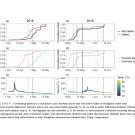
New research from The Complete Marsh Project reveals insights into phytoplankton rates in Suisun Marsh and serves as a useful tool to explore landscape-level variation in production and losses of phytoplankton.
Fish in the San Francisco Bay are currently under threat from harmful algal blooms known as red tides, which release toxins that can be fatal to aquatic life. Several factors, like high temperatures and low water flow in the Bay-Delta region, can trigger the occurrence of red tides.
Hot off the press! Check out the latest UC Davis Center for Watershed Sciences Open-Access publication by Andrew Rypel, revealing how ecosystem size affects community assembly via environmental stability, hydrology, and life-history filtering. A must-read for conservationists and ecologists!
The Center for Watershed Sciences is excited to share a newly funded Synthesis Incubator project to synthesize water temperature and wildfire data from rivers across the western United States to characterize spatiotemporal patterns of riverine heatwaves and how they might be affected by wildfire.
The Center for Watershed Sciences is excited to share a new funded Synthesis Incubator project to construct the first quantitative regional comparison of wetland fish communities throughout the San Francisco Estuary.
The Center for Watershed Sciences is excited to share a new funded Synthesis Incubator project to initiate development of an individual-based model of green sturgeon in central California that can be used to simulate effects of changing climate and water management on population dynamics, habitat use, and movement.
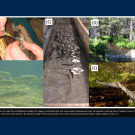
Floodplains are critical fish habitat, but can also strand fish when water recedes; new research shows which cues native & nonnative species use to avoid this fate.
Salmonid numbers are in decline across the western USA. Central Valley spring-run Chinook salmon's evolutionary significant unit (ESU) is extirpated from the San Joaquin River, and reintroduction efforts have resulted in poor survival of juveniles as they swim toward the ocean. Understanding the factors impacting outmigration survival is critical for population reestablishment. However, the effects of habitat variability have largely been overlooked in survival models that try to estimate where this occurs.
The Center for Watershed Sciences is excited to share that a new research project to quantify the relative risk of collapse for fish populations using the Sacramento-San Joaquin Delta has been funded by the California Department of Fish and Wildlife. Congratulations to PIs Jonathan Walter, Danny O’Donnell, Levi Lewis, and Andrew Rypel!
UC Davis Center for Watershed Sciences has received Prop 1 and other state grants to study the contribution of historic managed wetlands to ecosystem functioning in Suisun Marsh. The study will focus on plankton production and fish responses within managed ponds and adjacent sloughs under different management schemes, in an effort to 1) demonstrate the importance of historic working landscapes to marsh habitat; and 2) provide clear management guidance to optimize aquatic food production for both fishes and waterfowl. Read more about the proposed project!
"Confronting Climate Anxiety" is series in the works for ~one year. The series features Peter Moyle, Levi Lewis, and 6 other environmental scientists across campus to discuss how their work links to climate change and turns climate anxiety into climate action.
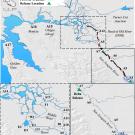
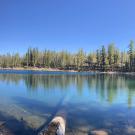
New research on Lahontan cutthroat trout – including growth experiments from 3 LCT strains and insights on the effort to reestablish LCT populations – was just published in PeerJ.
Spend your Sunday evening fishing for common carp in the UC Davis Arboretum while helping out with research on campus! You must bring your own fishing rod and have a fishing license. Reimbursement for a one day fishing license available! Please RSVP here to event. Learn more about carp research in the Arboretum waterway here.