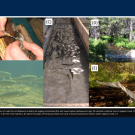
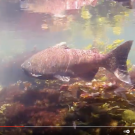
The pressure we experience on water in California exerts pressure on freshwater and fish habitat too. However, there are nature-based solutions that could help conserve and manage declining freshwater species. As one example, flooding rice fields in the winter could mimic the natural ecosystem species have evolved in and seems to support quite high survival and outmigration rates of juvenile salmon.
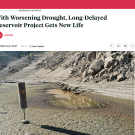
California's drought conditions are worsening and the state is looking at further options beyond local water conservation. There has been debate whether to revive the Sites Reservoir project, a massive and long-shuttered project set for the western Sacramento River Valley. On KQED, CWS Senior Staff Researcher Dr. Ann Willis, weighs in on how dams fit into our long-term water management strategy and why we need to rethink water management in California.
New research on Lahontan cutthroat trout – including growth experiments from 3 LCT strains and insights on the effort to reestablish LCT populations – was just published in PeerJ.
The Klamath Basin is on the cusp of the most ambitious dam removal effort ever attempted. If all goes to plan, efforts will get underway by next year to bring down the four aging hydropower dams that divide the basin in half. Are we ready for this?
Spend your Sunday evening fishing for common carp in the UC Davis Arboretum while helping out with research on campus! You must bring your own fishing rod and have a fishing license. Reimbursement for a one day fishing license available! Please RSVP here to event. Learn more about carp research in the Arboretum waterway here.
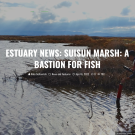
In a new blog on Maven's Notebook, Dr. John Durand, CWS Senior Researcher, describes the refuge Suisun Marsh provides for native fish species, as well as challenges, needs, and potential for partnerships at play for its management. Take a moment to learn about management of the largest contiguous brackish-water marsh on the USA West Coast at: https://mavensnotebook.com/2022/04/06/estuary-news-suisun-marsh-a-basti….
In this short clip, CWS Researchers, Drs. Ann Willis & Robert Lusardi, discuss the hopes and challenges in saving salmon and improving river ecosystems, as well as the type of research they conduct on the Little Shasta River.
Dr. Rachel Johnson has received the 2022 U.S. Fish and Wildlife Service's Rachel Carson Award for Scientific Excellence! Dr. Johnson is receiving this award for work in diagnosing and treating thiamine deficiency in Central Valley Chinook Salmon.
We are delighted to share that environmental law and policy professor and CWS Associate Director, Karrigan Börk, is the winner of the 2022 Distinguished Teaching Award.
Sign up and join CWS on March 26, 2022 at 11:00am PST for a special community mural painting event in Woodland! Community members will be invited to grab a paint brush to help us paint a large-scale mural on a local barn.
In a recent article "Untapped potential: leak reduction is the most cost-effective urban water management tool", Amanda Rupiper, Joakim Weill, Ellen Bruno, Katrina Jessoe (CWS Associate Director), and Frank Loge, combine economic and engineering principles to explore water utilities in the United States. Rupiper et al. 2022 propose a utility-specific economic model that helps identify when water leaks would be especially economically worthwhile to manage more effectively.