UC Davis Give Day is happening now through 5 pm April 15th. Building on a successful Give Day 2022, we at the Center for Watershed Sciences are delighted to announce a number of very generous donors have stepped up to create several unlockable challenge gifts that support the work we do at CWS and UC Davis. Any gift ≥$5 will help towards unlocking these challenge gifts. Will you help us reach our goal?
Tune in to the Annual Trout Camp Gala for a high-energy virtual showcase of innovative conservation work across the state, cameos from CalTrout staff, and more.
Postdoc positions available in Fish Ecology, Stream Hydrology and Environmental Flows
1 Postdoctoral Research Associate Position in Fish Ecology and Environmental Flows at University of California Davis, Center for Watershed Sciences, Davis, CA
1 Postdoctoral Research Associate Position in Stream Hydrology and Environmental Flows at University of California Berkeley, Department of Environmental Science, Policy, and Management
The Center for Watershed Sciences is hiring a Junior Specialist who will focus on studies of abiotic and biotic conditions that affect the ecology of invertebrate and vertebrate organisms in estuaries.
The Center for Watershed Sciences is hiring an Assistant Specialist to assist with salmon otolith and eye lens isotope projects in California to quantify critical rearing habitats for salmon viability.
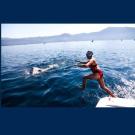
For the second year in a row, the Women for Water Research team will be swimming the 10-mile stretch for the Tahoe Environmental Research Center (TERC) and Center for Watershed Sciences (CWS).
Scientists for Public Engagement and Knowledge (SPEAK) is the Center for Watershed Sciences' communications and outreach program that connects the public with trusted science. SPEAK helps scientists make their research accessible, engaging, and influential.
The Center for Watershed Sciences is looking for two field-hardy, ecology-oriented students this summer to assist in a research project investigating the habitat-use of Sierra Nevada Yellow-Legged Frogs (Rana sierrae) in high elevation streams.
The California Extreme Precipitation Symposium is an informal day of scientific and technical presentations meant to increase our knowledge and understanding of extreme precipitation events. Goals of CEPSYM are to improve flood risk management planning and increase warning time for large floods.
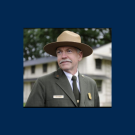
The Muir Institute will be hosting Jonathan B. Jarvis for a special lecture and book signing on his latest book “The Future of Conservation in America: A Chart for Rough Waters.”
The 10th Biennial Bay-Delta Science Conference is a forum for presenting technical analyses and results relevant to the Delta Science Program’s mission to provide the best possible, unbiased, science-based information for water and environmental decision-making in the Bay-Delta system.